
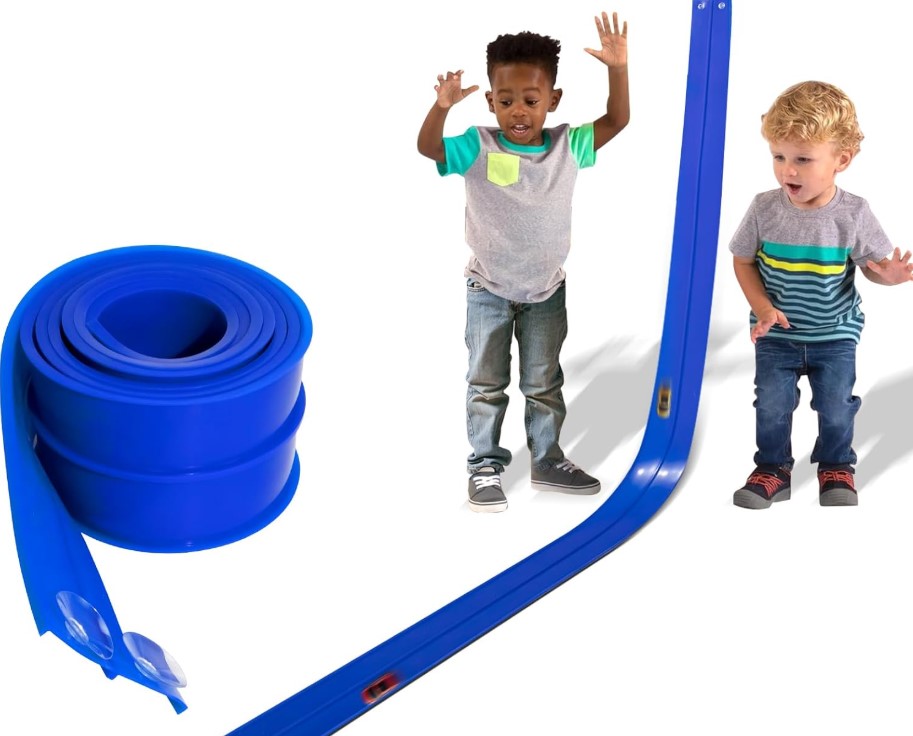
Parents often want a toy track for their kids that is simple to assemble, durable enough to survive everyday play, and creative enough to keep them engaged for weeks. A flexible track for kids offers exactly that kind of balance.
In this article, we explore eight powerful reasons why a flexible track consistently outperforms rigid, traditional toy tracks, not just at first glance, but long after the novelty fades.
These are benefits grounded in how children naturally play, develop, and learn. If you are comparing options, you’ll understand why many families return again and again to flexible track systems.
1. Openness and Creativity – Why Flexibility Matters
When children play with toys that don’t dictate how they must be used, magic happens. Flexible tracks provide an open-ended base for imaginative play. Studies show that open-ended toys, those without fixed rules or outcomes, encourage creativity, problem-solving, and independent thinking.
- Kids can bend, twist, and reshape the track to build hills, loops, tunnels, or winding roads.
- They invent stories around their builds, maybe a race through a city, a rescue mission, or a wild adventure.
- No two play sessions need to be the same.
Because flexible track toys do not constrain the play, children take the lead. That’s beneficial: open-ended play supports cognitive development, fine motor skills, and creativity.
A flexible track becomes not just a toy, but a blank canvas, and that is what makes it uniquely powerful.
2. Quick Setup, More Independent Play
One of the biggest frustrations with traditional rigid track sets is the time and effort needed to assemble them. Curves that do not fit, connectors that pop off, and repetitive assembly can quickly dampen enthusiasm. Flexible tracks avoid these pitfalls:
- Pieces slot or snap together easily.
- Bends and curves happen naturally, no force needed.
- Children often manage the setup themselves, without adult help.
When you go for a flexible track for kids you get a system that encourages independent play right away. Younger kids, even without perfect coordination, can often build a full track in minutes, then begin playing.

This ease of setup makes a big difference for families: it reduces the barrier for play, saves time, and means that the toy is more likely to be used, not left in storage. Over time, that ease encourages autonomy and frequent use.
3. Durability and Real-Life Play Resistance
Traditional tracks crafted from rigid plastic or fragile connectors often fail once children try to bend slightly, crash cars at speed, or rearrange parts forcefully. Flexible tracks, by design, absorb such stress. They bend, twist, and flex, and return to shape or stay intact.
Because flexible tracks rely less on fragile fixed connectors and more on resilient material that tolerates real-world use, they are better suited to how kids actually play: erratically, enthusiastically, and with physical energy.
This means less frustration for parents (no constant repairs) and more peace of mind that the toy will last, a big win in the long term.
4. Adaptability to Any Space, From Desk to Floor and Everything In Between
Rigid tracks often demand flat surfaces, a bit of floor space, or a specific layout to make sense. Flexible tracks are far more forgiving. They adapt naturally to available space:
- They can wrap around table legs, snake across sofa backs, or bend over uneven surfaces.
- They can be as compact or spread out as the space allows.
- They function well in small rooms, living rooms, or even during travel, wherever kids want to build.
This flexibility in layout makes the track more versatile. Whether children want a tight loop around a coffee table or a sprawling course across the floor, the track adjusts. This adaptability means the toy can remain relevant, even as household layout changes or the child grows older and demands more creative builds.
5. Development Benefits ─ Cognitive, Motor, and Social Skills

Flexible track toys fall under a larger category of “open-ended toys,” which research shows support a broad span of developmental skills.
Beyond motor and cognitive gains, open-ended play allows children to project ideas, create narratives, and socially interact in unstructured ways.
Because flexible tracks combine movement (cars racing) with open-ended structure, they offer a potent mix: both physical and intellectual stimulation in a playful environment.
6. Compatibility with Diverse Toys, One Track, Many Possibilities
Unlike many rigid track systems which accept only branded vehicles or specific car types, flexible tracks tend to be far more forgiving and versatile.
This compatibility means the track remains interesting even as a child’s toy collection grows. Instead of outgrowing the set, children integrate new toys, creating blended play scenarios. Instead of constantly buying brand-specific extensions, a flexible track can remain a central toy for months or years.
7. Easy Storage, Portability, and Family Friendly
Family life often involves travel, visits to grandparents, or simply limited storage space. Flexible track systems shine in those scenarios.
From a parent’s point of view, this makes a difference: less clutter, easier cleanup, and a toy that can go almost anywhere. For the child, it means the track is always ready. No digging through boxes or hunting for missing pieces, the toy remains accessible, and hence more likely to be used.
8. Longevity ─ Play That Grows With Your Child
One of the main problems with many kids’ toys is that they get outgrown too quickly. Rigid tracks often appeal to a narrow age range, maybe 3 to 5 years, after which their replay value drops. A flexible track, because of its open-ended nature and versatility, can scale with a child’s evolving imagination.

Because flexible tracks encourage creativity, problem-solving, and physical play, they remain relevant long after the initial excitement, often becoming a staple in the toy rotation rather than a forgotten bundle in storage.
9. The Science Behind Movement and Learning
Did you know that play involving motion and manipulation, like track toys, plays a powerful role in brain and body development? Research shows that open-ended play stimulates cognitive, motor, social, and emotional growth.
When kids plan a track, watch a car speed over curves, or predict where it might derail, they use spatial reasoning, fine motor skills, and cause-and-effect thinking. These skills are all part of early childhood development and help lay the foundation for problem-solving and creative thinking later in life.
That means choosing a flexible track is not just a matter of convenience or fun; it’s a decision that supports healthy, holistic development.
Final Thoughts
A flexible track for kids is not just another toy. It is a tool for creativity, development, and real play. Its flexibility, both literally and metaphorically, means it adapts to a child’s age, environment, mood, and imagination. It survives rough play, travels well, stores easily, and blends with other toys.
If you want a toy track that lasts beyond the first few weeks, that continues to challenge, delight, and grow with your child, flexible tracks stand out in a crowded market. They offer durability, developmental benefits, and long-term value. For parents focused on meaningful play, not just momentary distraction, flexible track systems are often the best investment.